Uncle chips
On my fading identity as the nephew of a cool uncle who drifted away.

I grew up in an adolescent city that was yet to grow up. Most pre-internet-era kids were excited about average kid things: going out to play, clumsy interactions with the opposite sex, video-games, summer holidays, birthday parties, colony festivals, school picnics, family outings, cartoons and gossip. I was one of these kids, too.
But nothing excited me more than a ringing doorbell. A doorbell held the promise of external company. Its sing-song tune signalled the prospect of guests. Guests who were mostly friends and relatives of my parents. I looked forward to these visits — announced and unannounced — more than my own friends knocking on the door with a bat or badminton racket. Anything felt possible when a new voice cut through our familiar space.
Maybe it was the welcome sight of adults other than my mom and dad. But it was more than just a monotony-breaking social event. When someone arrived, they arrived. Hope sat on their unsuspecting shoulders. I never wanted them to leave. Largely because it gave me a chance to see my parents pretend to be happily married. No bickering, no screaming, no shattered glasses — only a whole lot of chatting, laughing, forgetting and drinking. As long as someone was around, the house felt like a home. I remember begging one of their older friends to stay back the night because his car broke down in the rain. He stayed, and it was the highlight of my month.
When these guests left, the threat was instant, like a sinister serial killer emerging from behind the curtains. I was never scared of the dark, because it didn’t frighten me as much as the eerie silence that followed the sound of our front door clicking shut. Soon, more doors would be slammed shut. Anything felt possible when old noises cut through our familiar space.
The threat expanded when we moved to Mumbai. It was just the three of us, rebuilding and lashing out to feel seen in a big city. The nights were filled with outbursts of resentment and uncertainty. We had to start from scratch. Their fights found a different language — the kind spoken when hurtful words have a greater distance to cover in an emptier apartment. The words echoed between those walls for days after. There were no guests for a while. If the bell rang it was usually a polite neighbour checking in, without crossing the invisible boundary-line at the door. I’m sure they heard enough to know better.
Within months, we had a guest. A guest who, much to my joy and relief, wasn’t planning to leave anytime soon. Fresh from a heartbreaking divorce in New Delhi, my mother’s younger brother needed a new beginning. The arrangement was perfect: I would share a bedroom with him until he found his feet and finances in the expensive metropolis. In other words, I would finally have a…roommate. An elder sibling, even? He thought my parents were doing him a favour, but little did he know that he was doing me a bigger one. I initially thought he would be like Steve Carell in Little Miss Sunshine: the intellectual-but-suicidal man who moves in his sister’s family temporarily after a terrible breakup. But boy, was I wrong.
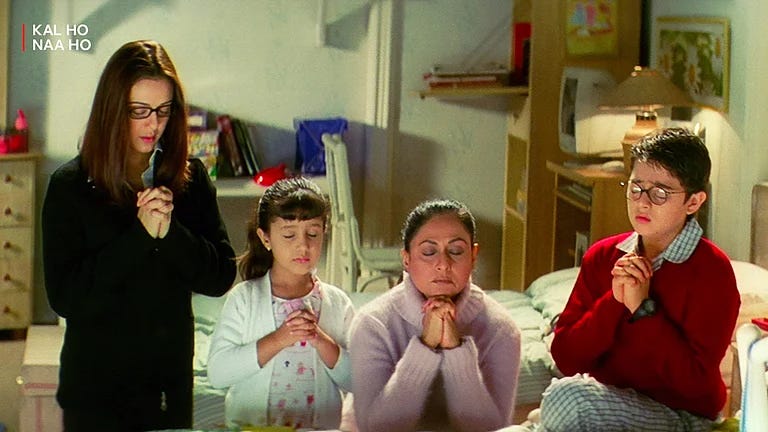
He was a 30-something advertising executive living the dream, like an eligible bachelor from a chick-lit novel. To me, though, he was a saviour sent from above. I couldn’t help but romanticise him. He was inexplicably cool. I always thought he resembled Shah Rukh Khan a bit, so there were times I saw him as a real-world version of Khan’s Kal Ho Naa Ho persona — a charming angel who swoops in out of nowhere to alter the fortunes of a family in crisis. (Only, he wasn’t dying of cancer). He went to parties, made friends by the dozen, dated through the weekends, danced in discos, brought colleagues home with their guitars and anecdotes.
My uncle single-handedly shifted the atmosphere of the house. My parents were too busy being amused by his exploits to turn their attention to each other. Maybe he reminded them of what it was to feel young(er) and untethered again. He enjoyed the attention. I did, too. Everyone was happier, smilier, livelier. I started to invite my college friends home so that they could meet him and envy me for having him. In the nights I teased him for his poor maths skills, and for his uncanny ability to have three girlfriends at once.
Sometimes when he tiptoed into the room at the crack of dawn, I saw him as a towering silhouette with a cape fluttering behind him. A rousing background score played in my head. He was no less than a superhero. Nothing was beyond him. On the more depressing days, I felt like Jimmy Shergill’s character begging Sanjay Dutt’s Munna Bhai M.B.B.S. to cure him with his personality. I dreaded his nights away; I locked myself in and drowned out the ‘din’ from the other bedroom. I even accompanied him to pubs, as the fawning teen-aged nephew who could have a beer that became our little secret. His friends took a liking to my parents (and the posh neighbourhood); guests started pouring in.
He stayed for nearly two years. When he finally moved into a tiny apartment not too far away from ours, I gatecrashed his peace on weekends and took notes on how to lead a carefree life. My mother sent me over to him during the Euro 2004 championship. She wanted me to be able to invite a friend over and enjoy the football without exposing us to the chaos of my dad losing his nth job.
Somewhere along the way, my uncle went through another divorce. My parents became his primary ‘relatives’ for his third wedding. He was determined to make the relationship work. My mother didn’t think much of the Sindhi family he was marrying into. He teased her for being too possessive; he warned her that she’d ruin her only son’s life if she continued to be so nosy. Tensions grew. My uncle grew older, no wiser, cooler, but he had other people to save now: his wife, their future, their status in a society that judged childless couples. There was a brief phase when I shared a flat with an ex-girlfriend who loved visiting the middle-aged newlyweds down the road. We became their guests. We played boardgames, ate and drank with them. After we left, we often heard raised voices behind us.
I can’t pinpoint the exact moment things changed. I don’t remember a definitive goodbye. I can’t recall the precise year in which we stopped being so fond of each other. Maybe it’s when I started adulting and yelled back at my uncle for being patriarchal and rude to my mom. Maybe it’s when I got too old to be rescued anymore. Maybe it’s when he moved to Gurgaon with his wife to start afresh. Maybe it’s when my mother and he got into several drunken property disputes on the phone. Maybe it’s when he told her she didn’t need much of the family inheritance because she had a son to provide for her. Maybe it’s when he stopped working and burned through said inheritance with failed businesses. Maybe it’s when he had two kids through surrogacy and I didn’t feel the need to be present for the early years of my ‘sudden’ cousins. Maybe it’s when he decreased contact and started visiting Mumbai without telling us. Maybe it’s when I didn’t get a reaction from him when one of his former friends died of alcoholism.
It’s been a slow-burning decay of attachment and mutual respect over the last decade. I don’t know what went down between the so-called adults of this family. And perhaps I don’t want to know. Denial helps me preserve those rose-tinted memories. My mother doesn’t speak of him much. My father doesn’t speak of anyone much. But I do miss my roommate. I do miss his metaphorical cape and mask. I do miss the influence he had on me in my most vulnerable years. He used to be the only one who’d call my dad out for being too arrogant; he was the only one who could criticise my emotional mom with a “didi” scattered across his sentences to soften the blow. I resent the fact that I paid the price as a no-agenda nephew caught in a family crossfire. I regret the fact that life happened and we left each other behind.
I wonder if he thinks of me. I wonder if he remembers the time I tried to console him after a broken engagement with a woman whose religion became a ‘problem’ for his shockingly conservative family. I wonder if he realised that I sensed how stifled he felt as a caregiver to sick and unpleasant parents. I wonder if he considered me mature enough to understand him. I wonder if he knows that I still drink at his favourite bar and proudly tell friends that the masala french fries on the menu was named after the manager who listened to his instructions one night (I call them “Uncle chips”).
On paper, we have no business falling out. I know it’s as simple as a random text message or phone-call. But we, as humans, are too conditioned to preserve our sense of nostalgia. Most of us are afraid to face the rekindling of estranged bonds because we risk displacing our limitless what-if fantasies with the cruel realities of detachment. We’d rather live in the melancholic glow of what could have been than confront the harsh clouds of what is. It supplies the storytellers in us. God forbid we confront the dry chasm between truth and expectation.
My fear is that if I call him, he will sound nothing like the devil-may-care drifter I once idolised. And I will sound nothing like the idealistic nephew who shadowed him like a grinning puppy. What if he’s forsaken all those trademark hip thrusts in nightclubs and his wicked sense of humour? What if I’ve forgotten my audacity to make fun of him for dyeing his chest-hair and cough musically? He always saw me as my mother’s son, so he might struggle to fathom me as an individual who is now older than he was when he reached our doorstep with Delhi-sized baggage. Worse, there’s a chance that he might treat me as someone who’s called to deepen the rift and sue him. I’m sure he’s caused my mom a fair amount of hurt, and vice versa, but I find it difficult to be mad at him. I can be mad about him for severing ties despite knowing of her Alzheimer’s. I want to feel let down. I really do. But I fail.
I fantasise about bumping into him in Delhi some day. I’ll probably recognise him and then look alarmed at how little he resembles the golden-light images in my head. I keep imagining that he’s following my career. That he secretly attends some of the panels I’m on. That he reads my reviews and marvels at the complicated sentences. That he scrolls through my social media accounts to stay updated. That he boasts about me to his children and friends. That he recalls my euphoric messages to him when Federer would win a title. That he expects me to get married so he can make good on his vow of paying for the wedding. That I’ll joke about how his multiple marriages normalised the ‘stigma’ of divorce in our strange family. That he will slip some cash into my hand because I’m still 18 in his mind.
“Uncle” is perceived as a boomer-coded slur these days, but he reclaimed the plurality of the term. I only have movie uncles as references now. I imagine how the future would have looked if my parents had passed away early and he was the only ‘responsible’ but unprepared guardian left — a la Casey Affleck in Manchester By The Sea, or Aamir Khan in Hum Hain Rahi Pyar Ke. I’m fine with people and places transitioning into the past tense, but I believe we have some incomplete business with each other. Nobody told me we were done for this lifetime.
A tragedy tends to renew lost relationships and reunite distant relatives. Perhaps that’s what it will take: the prodigal uncle appearing out of thin air for his sister’s funeral like Shah Rukh Khan (and his crisp white kurta) in Kabhi Khushi Kabhie Gham. Perhaps that’s when his return will morph into an arrival. And perhaps that’s when I might hear that familiar sound again. I’ll be even more excited. After all, some people choose to ring the doorbell despite having the house-keys.
Thank you for reading. I hope to keep these weekly essays independent, so please consider supporting this Substack with donations of your choice:
And of course, don’t forget to spread the word:
I know you wrote this focusing on your uncle, but I was stuck at the "trauma" of being alone withthe parents who never get along. I still remember leaving home early and coming home late, taking longer route in bus from college, just because I couldn't stand them. I still remember staying in college top late on Monday, because that was my father's day off. I learnt to make myself invisible, but little did I know how much that would cost me in future.
For a moment, I was wearing your skin. A beautiful and engrossing read.